
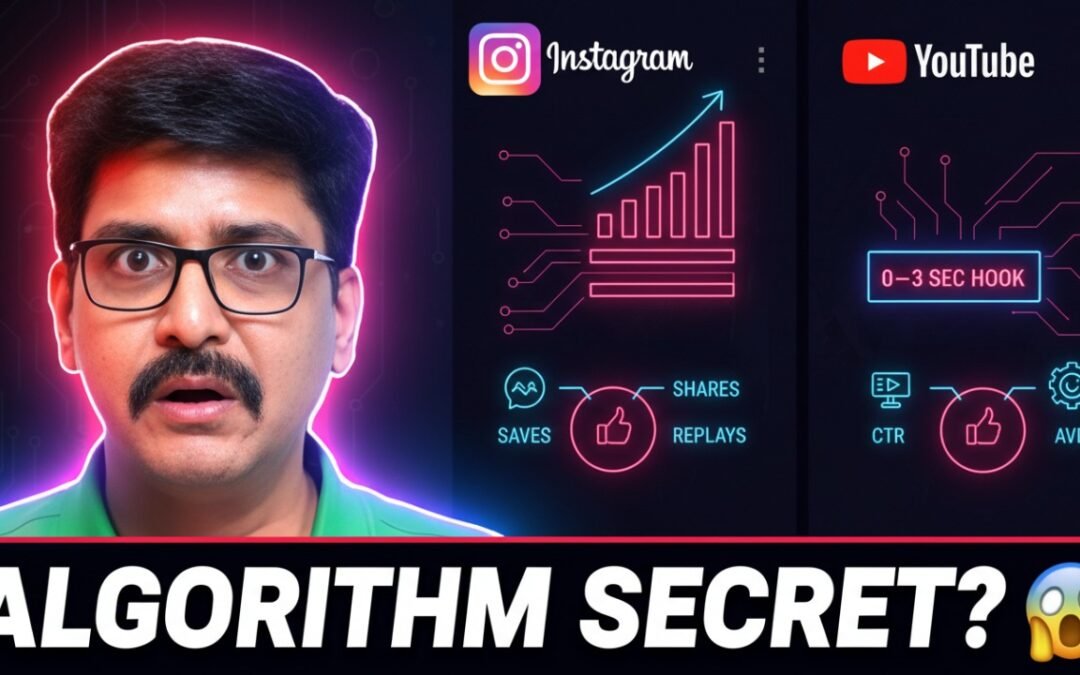
Social media algorithms are often treated like mystery creatures that decide your viral fate.
Creators keep asking:
- “Why did this reel get 1M views while the next one died?”
- “Why does my video suddenly stop reaching people?”
- “Is my account shadowbanned?”
The truth is simple: You cannot cheat the algorithm — but you can engineer it.
This blog unpacks the real technical architecture behind Instagram and YouTube’s recommendation engines and gives you a creator playbook that top global creators use to grow consistently.
Let’s decode the brain behind social platforms — machine learning systems, ranking models, velocity windows, decay behaviour, originality signals, and more.
1. What Is an Algorithm? (Simplest Explanation for Creators)
An algorithm is a set of rules + AI models + signals that predicts:
“What should we show you next so that you keep watching?”
A simple analogy:
Imagine a tea master who watches your daily order without asking and prepares the perfect tea for your taste.
The algorithm does the same — it learns your digital taste and personalizes your feed.
Algorithm = Data + Rules + Model + Goal
A. DATA (Signals the app collects from you)
Every action you take is a signal:
- Scroll speed
- Pause time
- Replays
- Likes / Shares / Saves
- Comments
- DM shares
- Caption reading time
- Device
- Time of day
- Language
- Search behaviour
More strong positive signals → your content gets pushed.
More negative signals → your content gets suppressed.
B. RULES (Integrity, Safety, Freshness)
Before a post reaches users, the system checks:
- Spam
- Clickbait
- Misinformation
- Violence/Nudity
- Re-upload duplicates
- Content freshness
C. MODEL (The AI brain behind the system)
This includes:
- Embeddings (meaning vectors for text, audio, video)
- Graph models (relationship patterns, co-view patterns)
- Two-tower recommenders (user tower + item tower)
- Bandit exploration models (testing new creators)
D. GOAL
Maximize Watch Time + Viewer Satisfaction,
Minimize Not Interested + Churn.
A simplified scoring formula looks like:
Score ≈ 0.4×p(Click) + 0.4×p(Long Watch) + 0.2×p(Save/Share) – Penalties
Higher score → higher ranking → more reach.
The 4-Step Recommendation Pipeline
- Logging (collect signals)
- Feature Store (convert actions into ML features)
- Candidate Generation (millions → thousands)
- Ranking (thousands → a few top posts)
This decides what your viewers see and whether your content travels.
2. Instagram Algorithm — Deep Breakdown (Feed vs Reels)
Instagram doesn’t have one algorithm. It has many.
The two most important:
A. FEED Algorithm (Relationship-based)
Feed ranking heavily favors:
DM replies > Shares > Comments > Likes > Views
Other factors:
- Recency
- Time decay
- Mutual interactions
- Story interactions
- Profile taps
Feed is about your social graph — “people you care about.”
B. REELS Algorithm (Interest-based)
Reels is a pure entertainment engine.
It does not care about your friends.
It cares about your taste.
1. Content Understanding
AI analyzes:
- Faces
- Objects
- Scene type
- Motion
- Text on screen
- Editing pattern
- Audio beat alignment
2. Real-Time Velocity Windows
Performance is evaluated in:
- First 30 minutes
- 2–6 hours
- 24 hours
Metrics that matter MOST:
| Signal | Weight |
|---|---|
| Completion rate | Extremely High |
| Loop / Replay rate | Extremely High |
| Shares & Saves | Highest |
| Comments | Medium |
| Likes | Low |
| Quick swipe (<1.5s) | Strong negative |
| Not Interested | Extremely negative |
C. Demotions & Penalties
Instagram reduces reach for:
- Misleading thumbnails
- Re-uploaded content (duplicate hash match)
- Engagement bait (“comment YES below”)
- Borderline content (medical, political, sensitive topics)
D. Pro Creator Tips for Instagram
- Add a 1-second visual contrast spike to stop the scroll
- Build a loopable ending (last frame connects to first)
- Use rising audio, not overused tracks
- Write a 2-line curiosity caption
- Post 3–5 reels per week to stay in the “warm user tower”
3. YouTube Algorithm — Proper Technical Breakdown
YouTube’s recommendation system is the most advanced in the world.
Its main surfaces:
- Home feed
- Suggested videos
- Shorts feed
Each surface uses multiple ML models.
A. Candidate Generation
Millions of videos → top few hundred
Based on:
- User viewing patterns
- Video embeddings
- Co-watch graph (people who watched X also watched Y)
B. The Ranker (Core of YouTube AI)
The ranker predicts:
- Expected Watch Time (EWT)
- Expected Satisfaction (ESAT)
YouTube even uses quick surveys after viewing to measure satisfaction, which directly affects ranking.
C. Mixer
The mixer blends:
- Subscriptions
- Home recommendations
- Suggested videos
- Topic diversity
- Freshness
4. Core YouTube Metrics (The Real Truth)
| Metric | Importance |
|---|---|
| CTR | Does the viewer click? |
| AVD (Average View Duration) | How long do they stay? |
| APV (Average Percent Viewed) | Did they complete most of the video? |
| Session Time | Did your video extend the viewing session? |
⚠️ High CTR + Low AVD
→ Clickbait → Demotion
🔥 Balanced CTR + High AVD
→ Strong Promotion
5. Shorts vs Long-Form — How They Connect
- Both use different models
- But there are cross-signals
- A viral Short can “warm up” your user profile
- Shorts loop % ≈ Long-form retention metric
6. Myth Busting — What Creators Keep Getting Wrong
❌ Myth 1: “Shadowban”
99% of cases = Not true
Usually caused by:
- Weak retention
- Poor originality
- Misleading thumbnails
- Negative viewer signals
Fix inputs → reach returns.
❌ Myth 2: “More hashtags = more reach”
Wrong.
Use 3–8 highly relevant tags.
❌ Myth 3: “Posting time is everything”
Posting time only affects initial warm viewers.
The real king metric → Retention.
❌ Myth 4: “Long videos don’t perform well”
False.
If retention is strong → long videos dominate suggestion surfaces.
7. Advanced Creator Lab — The Pro-Level Playbook
A. Retention Engineering
- Hook in the first 3 seconds
- Micro payoff every 20–30 seconds
- Remove all silences >300 ms
- Use 30–40% B-roll
- Create open loops and close them at 70% of the video
B. Title–Thumbnail System
- Curiosity + specificity
- 3–5 word thumbnail text
- High contrast colors
- Always A/B test two thumbnails
C. Metadata Spine
Your Title, Description, Chapters must follow one keyword direction.
This aligns the video for both Search + Suggested systems.
D. Velocity Window Strategy
- Instagram: drive meaningful comments in first 30 min
- YouTube: warm real human viewers in first 2 hours
Do NOT use bots or engagement groups — YouTube can detect them instantly.
E. Originality Footprint
To avoid re-upload penalties:
- Add a 5-second original audio sting
- Avoid repetitive templates
- Keep audio normalized at -14 LUFS
F. Funnel Strategy (Shorts → Long Form)
- End your Short with:
“Watch the full breakdown — link in description.” - Use end screens in long videos to chain related videos
G. Analytics Diagnostics
Instagram:
- Loop rate
- Completion graph
- Save/Share ratio
YouTube:
- Relative retention vs similar videos
- CTR per surface (Home vs Suggested)
- Suggested growth %
8. Weekly Creator Playbook (10 Steps)
A systematic weekly routine:
- Pick one topic cluster
- Write hook + 3 micro payoffs
- Script tight A-roll
- Edit aggressively
- Create two thumbnails
- Craft a strong English/Tanglish title
- Add search-intent chapters
- Publish → activate warm audience
- Reply to the first 20 comments
- Analyze retention dips → fix in the next video
This makes growth consistent and predictable.
9. Speed Cheats (High-impact shortcuts)
- Seamless loop for Reels
- High-contrast thumbnail
- Three-word headline on thumbnail
- Early save/share prompt
- Weekly experimentation with hooks and pacing
Final Thought
“You can’t cheat the algorithm. But you can engineer it.”
Give the right signals, and the algorithm will come looking for you.
Social media growth is not luck — it is design + behavior + consistency.
If you found this breakdown useful, explore more creator and tech insights at:
gcloudtechphile.com