
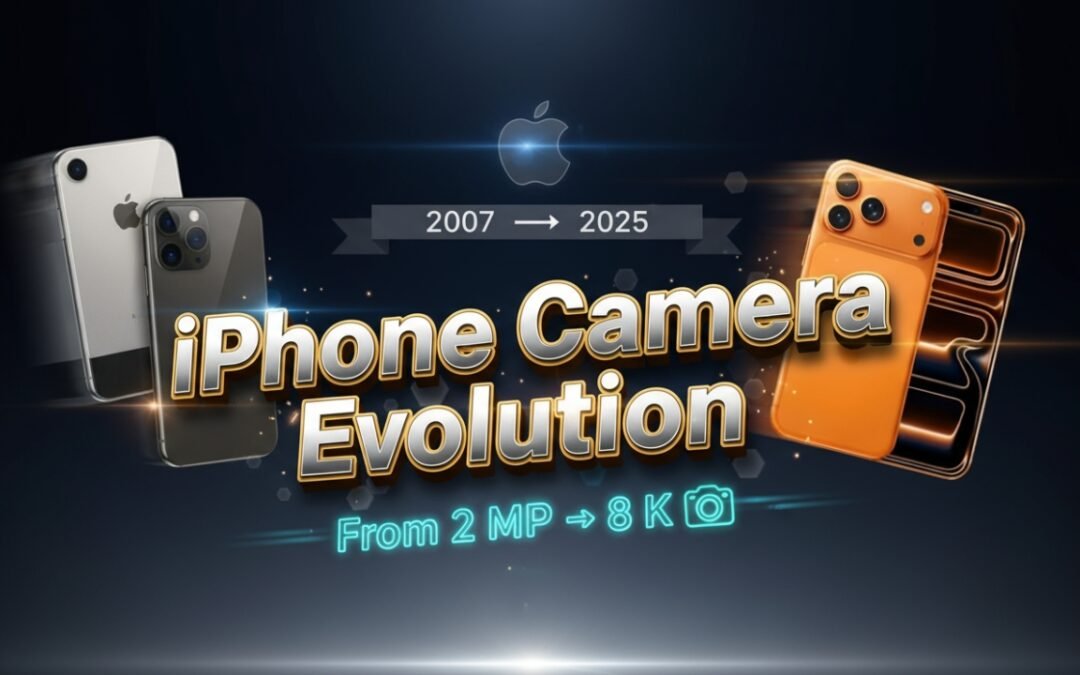
The iPhone camera evolution is one of the most fascinating stories in modern technology. From a simple 2 MP sensor in 2007 to today’s mind-blowing 48 MP camera with 8K video recording, the iPhone has transformed the way the world captures photos and videos.
“Camera quality” has become the biggest identity of iPhones — and for good reason. Apple’s camera engineering changed mobile photography forever.
In this blog, we take a detailed look at how the iPhone camera evolved from the first model to the latest 2025 iPhone 17.
Let’s begin the journey!
📸 iPhone 1 – 2007
The journey started here. The first iPhone arrived with:
- 2 MP rear camera
- No flash
- No front camera
- No video recording
Despite the limitations, this was the phone that redefined smartphones. Mobile photography was simple — just point and shoot.
iPhone 1 proved that the camera didn’t have to be huge to create a revolution.
📸 iPhone 3GS – 2009
The first meaningful camera upgrade.
What Changed:
- 3 MP camera
- Video recording arrived (480p resolution)
- Auto-focus was introduced
The selfie era also began, thanks to the introduction of the front camera around this time.
For those years, recording video on a phone was a big deal — and Apple delivered.
📸 iPhone 4 – 2010
A major leap in both design and camera.
Upgrades:
- 5 MP rear camera
- LED flash
- Front camera for FaceTime
- HDR photos
- Retina Display launched
FaceTime changed how people video-called forever. HDR made photos richer and more dynamic.
This phone marked the beginning of Apple’s dominance in mobile photography.
📸 iPhone 5s – 2013
This generation focused on refining quality.
Highlights:
- 8 MP camera
- True Tone flash
- Slow-motion video (120 fps)
- Larger pixels for better low-light
- Touch ID arrived
Slow-motion video caught on instantly — and content creators finally got smoother creative options.
📸 iPhone 6 & 6 Plus – 2014
This was the year stabilization changed everything.
Features:
- 8 MP camera
- Optical Image Stabilization (OIS) on 6 Plus
- Better low-light performance
- Faster focusing
OIS made videos smoother and photos cleaner — especially in dark environments. This was a major milestone.
📸 iPhone 7 & 7 Plus – 2016
Two cameras = double the possibilities.
Game-Changer Features:
- Dual-camera system on iPhone 7 Plus
- Wide lens
- Telephoto lens
- Portrait Mode introduced
- 1080p slow-motion
- Optical zoom support
Portrait Mode created DSLR-like background blur and became one of Apple’s biggest photography breakthroughs.
📸 iPhone X – 2017
A historic release in many ways.
Key Camera Upgrades:
- 12 MP rear camera
- TrueDepth camera system
- Face ID
- Portrait Lighting
- 4K video at 60 fps
- Animoji
The TrueDepth camera was a technological masterpiece — unlocking advanced depth sensing and accurate face recognition.
And the notch? It became iconic worldwide.
📸 iPhone 11 / 11 Pro – 2019
The trio-camera revolution.
Major Additions:
- Ultra-wide lens
- Night Mode
- Deep Fusion
- Better Smart HDR
For the first time, iPhones had:
- Wide
- Ultra-wide
- Telephoto
…all in one device.
Night Mode alone made this series legendary in low-light photography.
📸 iPhone 12 / 12 Pro – 2020
This generation was all about professional video.
Highlights:
- LiDAR scanner for faster low-light focus
- Dolby Vision HDR video
- Enhanced stabilization
- Better Night Mode across all lenses
Dolby Vision on a phone was unheard of — Apple made iPhones the best video machines in the world.
📸 iPhone 13 / 13 Pro – 2021
A huge jump in resolution and stability.
Key Features:
- 48 MP main camera (Pro Max)
- Cinematic Mode
- Action Mode for super stabilization
- Better sensors & AI enhancements
Cinematic Mode introduced depth-control and automatic focus shifts — like Hollywood movies.
📸 iPhone 14 / 14 Pro – 2022
Still continuing the 48 MP excellence.
Upgrades:
- Better Night Mode
- Improved HDR
- Advanced Photonic Engine
- Even better stabilization
Apple perfected low-light photography here.
📸 iPhone 15 / 15 Pro – 2023
The zoom monster.
What’s New:
- 5x periscope optical zoom on Pro Max
- Smart HDR 5
- Better low-light capture
- 8K shooting support in ProRes
Suddenly, mobile zoom photography became professional-grade.
📸 iPhone 17 – 2025
The latest milestone.
Features:
- 48 MP triple camera system
- 8K Dolby Vision recording
- Advanced neural processing
- Better stabilization
- Improved sensor shift technology
By 2025, iPhone cameras became full-blown cinema tools.
From simple 2 MP photos to Hollywood-grade 8K videos — the transformation is unbelievable.
⭐ Why iPhone Cameras Keep Getting Better
The iPhone camera evolution is not just about megapixels. It’s about:
- Sensor size
- Lens quality
- Smart HDR
- Deep Fusion
- Computational photography
- Machine learning
- Image signal processors
- Software + hardware optimization
Apple focuses on combining hardware excellence with computational photography — giving unmatched consistency.
Even with the same MP count, iPhone photos often outperform competitors because of superior processing.
⭐ iPhone Camera Evolution Summary (2007–2025)
| Model | Year | Camera Highlights |
|---|---|---|
| iPhone 1 | 2007 | 2 MP, no flash |
| iPhone 3GS | 2009 | Video recording added |
| iPhone 4 | 2010 | 5 MP, HDR, FaceTime |
| iPhone 5s | 2013 | Slo-mo, True Tone flash |
| iPhone 6 Plus | 2014 | OIS |
| iPhone 7 Plus | 2016 | Dual cameras, Portrait Mode |
| iPhone X | 2017 | Face ID, TrueDepth |
| iPhone 11 Pro | 2019 | Ultra-wide, Night Mode |
| iPhone 12 Pro | 2020 | LiDAR, Dolby Vision HDR |
| iPhone 13 Pro | 2021 | Cinematic & Action Mode |
| iPhone 15 Pro | 2023 | 5x optical zoom |
| iPhone 17 | 2025 | 48 MP, 8K video |
⭐ Final Thoughts
From 2 MP snapshots to 48 MP pro-grade photos…
From shaky videos to buttery-smooth 8K cinematic footage…
From basic lenses to advanced LiDAR sensors…
The iPhone camera evolution is truly extraordinary.
Now your turn:
👉 What feature do YOU want in the next iPhone camera?
Better zoom? 3D capture? 16K video?
Comment below!
If you found this helpful, share it with another iPhone lover.
And for more tech content, visit gcloudtechphile.com.
Hope you learned something new. Ungala next blog-la paakalam… Until then, Good Bye Techphiles! 🚀📸